

E1 Boiler Fault Code: Causes & Fixes
.avif)


Thinking about a new boiler?
If you’re exploring your options, we can give you a fixed-price boiler quote in under a minute, with next-day installation available.
What Does The E1 Boiler Fault Code Mean?
The E1 (or E01) boiler fault code will cause your boiler to go into lockout mode. This is a safety precaution.
In some cases, continued operation would mean the boiler could be dangerous, or, continued operation could damage internal components.
For the majority of combi, system and regular boilers the E1 error code relates to one of the following:
This error code is displayed on a range of Baxi, Main and Potterton boilers, with the most common cause being low water pressure.
Top 4 Causes & Fixes
Below, we’ll discuss the top 4 issues that lead to the E1 fault code being displayed, as well as the quickest, easiest and cheapest fixes.
Think you need a new boiler? Find out how much a boiler change costs here.
- Low Boiler Pressure
The most common reason a boiler shows the E1 error code on the display is due to low system water pressure.
Typically, you should expect your boiler’s pressure gauge to show 1.0-1.5 bar when cold and 1.5-2.0 bar when hot. If it drops much below 1.0 bar, the printed circuit board notices that your heating system’s pressure isn’t high enough and your boiler will lock out.
The most common culprit when it comes to low boiler pressure, is a leak in your heating system. If you add water to your system the pressure increases and if it loses water (via leaks), then the system pressure drops.
So, where is your heating system likely to be leaking from?
- Radiator valves
- Pipework, especially old and weak soldered fittings
- Boiler pump
- Pressure release valve
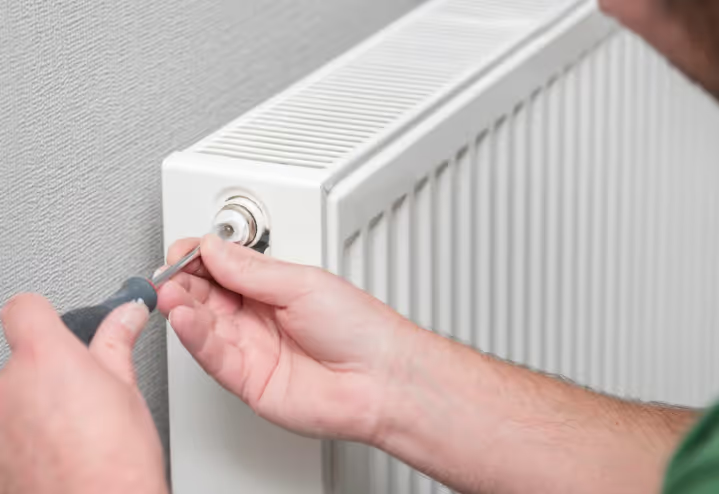
As a side note, bleeding radiators of air helps your system run a lot more efficiently. However, when you bleed radiators of air, this also drops the pressure in your heating system. If you’ve recently bled radiators, this could be the reason for the drop in boiler pressure.
Other culprits for low system pressure can be found in our guide to the F1 boiler fault code here.
How To Fix Low Boiler Pressure
Low boiler pressure is the most common cause of the E1 fault code showing on modern boilers. Luckily, the issue is usually a cheap and easy (DIY) fix.
The 6 step process to fix the E1 boiler fault code is as follows:
Your boiler's pressure should be 1-1.5 bar when cold and 1.5-2 bar when hot. The filling loop introduces water into the system and in turn, increases pressure. For this reason, ensure the valve you used to increase boiler pressure is completely closed before resetting your boiler.
On a side note, adding water to a system is likely to introduce air. So, it's always wise to bleed your radiators. Open the bleed valve until the hissing noise stops (that's air escaping) and water starts to dribble from the bleed valve.
Keep checking the boiler's pressure gauge as you bleed each radiator. Bleeding air from radiators drops the boiler's pressure; you may have to rinse and repeat bleeding / topping up your boiler's pressure a couple of times.
Once done, reset your boiler and this will clear the E1 fault code.
- Ignition Failure
Modern boilers in the UK use an electronic ignition system. This system lights the burner when you call for central heating or hot water.
An ignition failure (lack of flame) is a possible culprit when it comes to the E1 boiler fault code. This could be from an electrode that is covered in carbon or cracked. The electrode is then not able to generate a strong enough spark to ignite a flame.
You'll have the same issue if the ignition lead is worn or the spark generator isn't working.
If you're hearing clicking noises (repeatedly) but your hot water and central heating isn't working, one of the above issues could be your problem.
How To Fix An Ignition Failure
An ignition failure likely relates to an electrode that's old, corroded, or that has failed completely. Like most work on boilers, this diagnostic and fix should only be completed by a Gas Safe engineer.
Generally, you'd expect to pay £200-£300 for a replacement electrode or ignition leads for the likes of Main Eco Elite, Potterton and Baxi boilers.
If you suspect an ignition fault of any kind, check out our guide to the L2 fault code here.
- Flame Detection Fault
Another reason the E1 boiler fault code is displayed on your boiler's display is due to what's known as a flame detection fault.
As the ignition sequence begins your boiler's printed circuit board (PCB) expects to receive a signal from the flame sensor (known as the ionisation probe), signalling that there is a flame.
If there isn't a positive signal from the flame sensor, the PCB will send a signal to the gas valve to shut off. If it doesn't gas will continue to flow, yet, it wouldn't be ignited. Unburnt gas in the combustion chamber could be dangerous, so this is a safety precaution.
But what is the reason for a flame detection fault?
The most common reasons for the E1 error code being displayed in this case are:
- A dirty (carbon coated) flame sensor, meaning the flame signal isn't strong enough
- Damaged or worn flame sensor, leading to no signal being sent to the PCB
- A faulty PCB that misinterprets the flame signal
If any of these issues are present, you might find that your boiler attempts to ignite a few times, then cuts out completely (safety lockout).
How To Fix A Flame Detection Fault
For boilers where the E1 fault code relates to a lack of flame (or, flame detection fault), you'll need a Gas Safe engineer. They'll need to check the gas isolation valve is open, as well as checking the flame sensor for faults. If the flame sensor is completely faulty, this will need to be replaced.
Expect a replacement flame sensor to cost in the region of £150-£250, depending on the exact boiler model you own. A more expensive fix is a faulty PCB. The PCB is the brains of your boiler and sometimes, the fix is as simple as resoldering wiring.
However, if a replacement PCB is needed, expect this to cost upwards of £400.
Think your PCB is to blame? We’ve got a full guide to PCB faults here.
- Gas Supply Issue
In order for your boiler to work in a safe manner and maintain proper combustion, it needs stable gas pressure. When pressure drops below manufacturer's specifications, your boiler's PCB will notice and lockout the boiler until the issue is fixed.
If you've noticed other gas appliances operating unusually (such as your gas hob flickering), this could highlight low gas pressure as a potential issue.
The main reasons for a drop in gas pressure include:
- Airlocks - This is common after long periods where your gas / boiler hasn't been used, or, after recent gas supply work
- Closed or partially closed isolation valve - Common after recent gas supply work
- Faulty or stuck gas valve - Common in older boilers as gas valves are known to stick, or, fail completely
How To Fix A Gas Supply Issue
Checking the gas supply is something that needs to be done by a Gas Safe engineer.
They'll want to:
Depending on what exactly is wrong with your boiler and gas supply, expect the fix to be in the region of £150-£500.
As an example, a typical gas valve replacement on popular boilers such as Vaillant, Ideal, Worcester and Viessmann generally costs in the region of £275-£375.
How To Prevent E1 Errors
There are things you can do to help prevent the E1 boiler fault code resurfacing in the future, including:
- Maintain correct boiler pressure (generally around 1.5 bar)
- Service your boiler on an annual basis, ensuring checks are carried out on the flame sensor, gas pressure and ignition components
- Monitor early warning signs (ignition clicking or pressure drops) and contact a Gas Safe engineer if you suspect an issue
FAQ
What does the E1 code mean on my boiler?
The most common reason a E1 fault code is displayed on modern boilers is due to low boiler pressure.
Low boiler pressure generally signifies a leak. You’ll need a Gas Safe engineer to find and fix the leak, before topping up your boiler’s pressure. Once this has been done, resetting your boiler will clear the E1 fault code.
Is the E1 error code dangerous?
No, the majority of boilers showing the E1 fault code are not dangerous.
However, as this issue generally relates to a water leak, it’s worth getting it fixed as soon as possible. Leaks can ruin plastered walls, boiler components and electrics, all of which are very costly to repair and replace.
Can I reset my boiler myself?
Yes, modern boilers are easy to reset. Most boilers (such as the Ideal Logic Plus) have a reset function just above the display panel on the front of the boiler.
How long does it take to fix the E1 boiler error code?
Topping up a boiler’s pressure and resetting a boiler generally only takes a few minutes if you know what you are doing.
However, it’s worth spending the time to get a Gas Safe engineer to fix the leak that caused the pressure drop in the first place.
And that’s it for our guide to the E2 fault code…
- Got questions about boiler issues or a boiler replacement? Speak to our experts here
- Read our big guide to why your boiler is not working here
- Get quotes on a new boiler here
