

How Are Solar Panel Systems Installed?



Thinking about solar?
Curious what solar panels could save you? Get a quick estimate based on your home, and see if solar makes sense for you.
In today’s guide, we’ll cover everything you need to know about how solar panels are installed, and how long it takes.
This covers everything from:
All Dwellow’s solar panel installations are completed by an MCS professional. Get a quote on your solar panel system by jumping over to our page here.

Alternatively, if you’re looking to understand expected costs, read our guide to solar panel installation prices here.
4-Step Solar Panel System Installation Process
PV solar panel system installation isn’t a simple DIY project. We’d always suggest using a professional and in this case, you’ll want a professional registered with the Microgeneration Certification Scheme (MCS).

The MCS focuses on providing training as well as recognised industry standards for low-carbon installations. These include the likes of: air source heat pumps, biomass boilers and of course, solar panels.
Using a MCS registered solar panel installer has a two-fold benefit:
- Your installer works within existing framework for green energy system design and installation, ensuring a high quality end product
- Your system will be eligible for the Smart Export Guarantee (SEG); earn money by selling excess electricity back to the grid
Only installations with a MCS certificate will be able to tap into the grid to earn an income from excess electricity production. Savings for these installations on average are up to £600 per year, in comparison to £300 for those not utilising the SEG.

Get your fixed price for installation using our solar panel page here; all of our installations are MCS certified.
Or read more about picking solar panel installers here.
Step 1: Gain Roof Access

Due to The Work at Height Regulations 2005, installers aren’t able to use ladders as it’s simply not considered to be safe. Instead, they’ll need to use a “raised platform”.
So, the first thing they need to do before starting your solar panel installation is to erect scaffolding to gain roof access. Typically, this would take less than half a day for a small team, and a further half day to take it down once the installation is complete.
In some instances, where the roof can’t be easily accessed even when using scaffolding, your installer may need to use either a scissor lift or cherry picker.
Bear in mind that any installation needing a scissor lift or cherry picker is likely to be subject to an additional cost in comparison to a standard solar panel installation.
Step 2: Install Solar Panel Frames & Mounts
Solar panels are heavy (approximately 20 kg each), not to mention extremely fragile.
For this reason, they can’t be directly screwed into your roof tiles or roof rafters, they’ll need a secure mount and this itself needs to be secured to your roof.
Your solar panel installers will need to screw anchors into the rafters, usually by lifting up a few of your tiles. These anchors allow substantial mounts to be fitted, ones that can hold the weight of solar panels.
Once your MCS installer has installed the anchors, they’ll be able to put your roof tiles back and install both the mounts and solar panels, and move onto wiring up the system.
Step 3: Wiring The System
The next part of solar panels being installed is wiring up the system.
All systems will need an inverter and consumer board installed and wired up. The inverter works by taking the direct current (DC) electricity produced by the solar panels and converting it to alternating current (AC).
Without the inverter, the electricity produced by solar panels would be useless!
If you plan on having a solar battery fitted, this then needs to be wired up to the inverter. Remember, not all solar panel systems use a solar battery.
Typically, you only need a solar battery if you are out most of the day. In this case, your panels generate electricity whilst you’re not there to be stored in the battery, and you use that electricity in the evenings, directly from the battery.
To find out more, read our guide to solar panel battery storage.
Or, use our solar panel page here. Click a few options and our tool will determine what size (if any) solar storage battery you need installed.
Step 4: Testing & Commissioning Your System
Testing and commissioning your system is the final part of your solar panel installation. Your installer will test each aspect of your system to ensure it’s working, including:
Once your system has been tested, it can be commissioned.
And once your solar PV panel installation is commissioned by a MCS installer, you’ll have a MCS certificate. It’s this certificate that qualifies you for the SEG, meaning you can sell any excess electricity back to the grid!
FAQ
Can I Complete a DIY Solar Panel Installation?
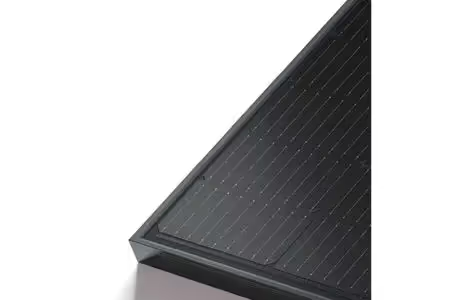
Unlike boilers where only Gas Safe engineers are the only ones legally allowed to work on these units, you don’t have to use a MCS certified solar panel installer; you can install solar panels yourself.
However, this isn’t advisable. As DIY projects go, this isn’t just an incredibly complicated one, it’s an extremely big one too. And whilst it might look “easy” due to it being completed on average within a few days, remember there are a range of professionals involved including:
- Scaffolders (or cherry picker / scissor lift operators in some cases)
- Solar panel installers
- Electricians
If you want a system spec’d to be as efficient as possible and also want to gain access to SEG so you can sell energy back to the grid, you’ll need to use an MCS installer.
All of our installers are MCS certified. You can get fixed prices for solar panel installation here.
How Long Does It Take To Fit Solar Panels?
An average 3kW-4kW solar panel installation (suitable for a 3-bedroom property) is likely to take approximately 2 days to install.
This includes gaining roof access (by setting up scaffolding) all the way to connecting the system ready to produce electricity for your home, or sell electricity back to the grid.
How Are Solar Panels Attached To A Roof?
Solar panels are attached to roofs using anchors and mounts. The anchors are usually secured to the rafters in your roof, and the solar panel mounts are attached to these anchors.
Solar panels weigh around 20 kg, so simply screwing them into tiles or rafters is not going to keep them in place during periods of high winds.
How Are Solar Panels Connected To Household Electricity?
By using an inverter. Your solar panels produce direct current (DC) electricity, but your house uses alternating current (AC). The inverter's job is to convert DC to AC, so the electricity is usable.
Typically a micro inverter is favourable over a string inverter. Put simply, if any panel is damaged or shaded (producing less electricity than others), it will reduce the efficiency of all panels in your system when using a string inverter.
When using a micro inverter, efficiency of other panels won’t be affected. You can read more about solar panel inverters here.
Is My Roof Strong Enough For Solar Panels?

If in doubt, have a site survey. But in general, if your roof is less than 20-years old and still under warranty from your home builder, then it will be strong enough to take the weight of solar panels.
Speak to our advisors here, and they’ll be able to determine if your roof is suitable for a full-scale installation.
