

Solar Panels For New Builds: Costs & Regulations


Thinking about solar?
Curious what solar panels could save you? Get a quick estimate based on your home, and see if solar makes sense for you.
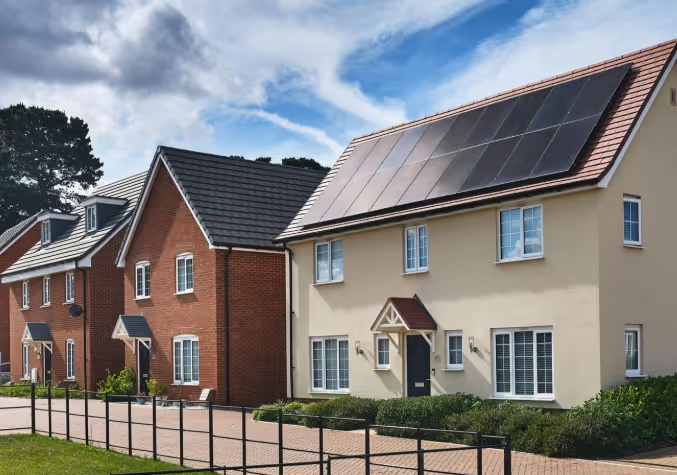
It's becoming more and more common to see solar panels on new builds. Not only are building regulations relating to energy efficiency tightening, but many new build buyers now see solar panels as a standard feature.
Installing solar panels during a build has huge advantages. Not only does it contribute to helping a new build hit SAP and EPC targets, it's also a lot cheaper than retrofitting them after a build is complete (which is what many buyers ask for).
Below, we'll dig into solar panels for new builds covering the likes of:
- Cost
- Regulations
- System design
- Battery storage
If you're a new build owner, self builder, property developer or architect looking for a solar panel installer, contact our solar panel experts here. Or, if you’re looking to retrofit solar panels to your new build, use our clickable solar panel quote form here.
Cost of Solar Panels For New Build Houses
Installing a solar panel system on a new build during the construction stage is likely to cost somewhere between £6,000-£8,000. This is the cost without a storage battery.
Installation costs will vary depending on a range of factors including the likes of:
A typical UK property is likely to need anywhere between a 2kW-5kW system. This will vary depending on your focus, whether that be on self-sufficiency, energy bill savings, return on investment or a balance of all three.
Solar batteries (which we'll explain in more detail below) are incredibly expensive. Depending on capacity, expect solar battery storage to add £3,000-£6,000 onto the initial installation price.
For a 3-4 bedroom property, this means a suitable system is likely to be £9,000-£14,000; this includes panels, storage battery, inverter and labour for installation.
As an example, we fit the following system for under £9,000.

As part of the price, we include:
You can easily generate solar panel quotes for your new build using our clickable pricing tool here. Or, check out our full guide to solar panel installation costs.
Building Regulations For New Homes
Solar panels are installed on new build houses to help them comply with Part L Building regulations.
As part of these regulations, properties are measured by SAP (Standard Assessment Procedure). All new build properties' DER (Dwelling Emission Rate) must be lower than TER (Target Emission Rate).
There are plenty of ways to reduce the DER of a new build property. This includes fitting energy efficient products such as high quality insulation and doors. But, one of the most popular ways to reduce DER is by installing solar panels.
Typically, a small 3-4kW solar panel system is likely enough to improve a SAP score of a property considerably, helping it fall inline with Part L Building regulations.
Of course, the exact size of a solar panel system needed to reach the required DER will depend on:
- Floor area and overall property size
- Insulation
- Quality of windows and doors
A property with only a "reasonable" EPC/DER may need a larger solar panel system in order to be under TER.
We install heat pumps and solar panels, both of which help new build homes to reduce their DER.
You can get quotes on solar panels here, as well as quotes on heat pumps here.
Solar Panel System Design
Designing a solar panel system should be done before construction, not during. This way, you'll be able to make a SAP calculation to ensure the property beats its TER when accounting for other energy efficient installs (heat pumps, insulation, windows etc).
Roof orientation and layout will play a major role when it comes to what size system your new build needs and the impact it has on your overall SAP score.
When estimating system size required, your installer will take into account:
If you're looking to improve the saleability of your new build development, but also, meet DER, speak to our solar panel experts here.
Solar Battery Storage
Once your solar panel system is installed, electricity can be used as it's generated. However, direct consumption is generally only 30-40% of electricity produced.
As part of an installation, your installer will set you up on the Smart Export Guarantee (SEG) scheme. Any excess electricity can then be sold back to the grid, which provides the property owner with a small but regular income.
On most occasions, a property will sell energy back to the grid, only to buy it back later at a higher cost; this is where a solar storage battery comes in. The property owner can store the excess electricity for use at a later date.
Instead of consuming 30-40% of electricity produced, an adequate solar battery can easily bump this figure to 60-75%.
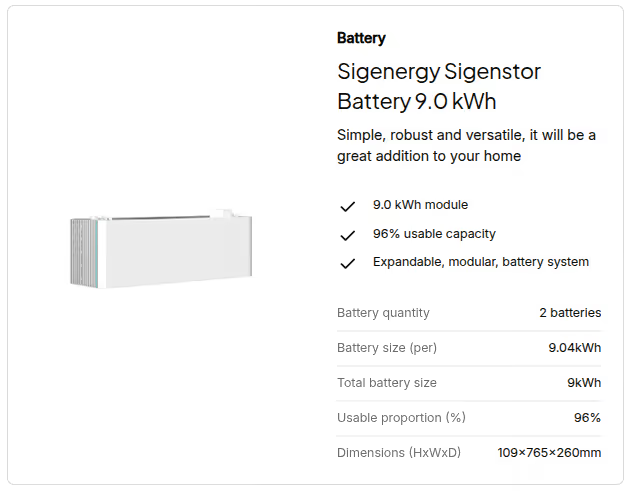
Even a small solar battery (5kWh) will help to bump this consumption figure. However, we'd suggest a medium battery storage (9kWh). This offers the best balance of cost vs return for the average 3-4 bedroom property.
One of our most popular systems incorporates a durable set of batteries (9kWh) total from Sigenergy:
Systems can easily be designed to power high electricity consumption appliances such as heat pumps, air conditioning units and EV chargers.
Spec your system (inclusive of a storage battery) using our clickable solar panel pricing tool here.
FAQ
Are solar panels compulsory on new builds?
Solar panels are not compulsory on new builds. However, each new build property needs to hit a certain Dwellings Emission Rate (DER) as part of Part L Building Regulations.
Installing the likes of a heat pump and solar panels helps to reduce DER significantly.
How many solar panels does a new build need?
The majority of 3-4 bedroom new build houses will need 8-12 solar panels (depending on their exact wattage) to create a 3-5kW system. However, self builders and property developers need to design their system to ensure it can pass a SAP (Standard Assessment Procedure).
Do solar panels help improve EPC ratings?
Yes, thanks to the fact they create renewable energy, they help towards improving the SAP on new builds. This directly helps to improve the overall Energy Performance Certificate (EPC) rating for new properties.
Should I buy solar battery storage for my new build?
Whilst optional, installing a solar battery is advisable. Utilising the correct size solar battery is likely to bump your self-sufficiency from approximately 30-40% to 60-75%, reducing energy bills massively.
Without a solar storage battery, the property owner would sell energy back to the grid, only to purchase it at a later date for a much higher cost.
Are there any grants for solar panels?
Unlike heat pumps (£7,500 grant available), there aren't currently any cash based grants for solar panels. However, you can earn an income from the Smart Export Guarantee, as well as get 0% VAT (rather than paying 20%) on solar panels, inverters, mounting systems and battery storage.
Are solar panels cheaper to install during construction?
Yes, retrofitting solar panels after construction is much more complicated than installing them during a build. This means the installation cost of retrofitting is much higher.
You'll want to design and install your system before you start building to ensure your build meets Part L Building Regulations.
Are you a property developer, self builder or new build homeowner? Contact us here if you still have questions. Or, jump over to our solar panel quote form here to get prices on-screen.
