

Faulty Boiler Heat Exchanger Replacement Cost
.avif)


Thinking about a new boiler?
If you’re exploring your options, we can give you a fixed-price boiler quote in under a minute, with next-day installation available.
How Much Does a Boiler Heat Exchanger Cost To Replace?
Replacing a faulty heat exchanger is not a simple job, it's a major repair. Many boiler repairs can be completed by simply removing the front panel from your boiler. This isn’t the case when it comes to a heat exchanger replacement.
Not only are heat exchangers expensive to purchase, the job of replacing one is extremely complex. The heat exchanger is connected to the burner, fan and pipework, meaning your Gas Safe engineer will have to disassemble a huge portion of your boiler in order to access it.
Expect the cost of a replacement heat exchanger to cost in the region of £450-£750.
Average Heat Exchanger Replacement Cost
The cost of your boiler repair will include an initial diagnostic (to pinpoint the heat exchanger being at fault), which is likely to sit in the region of £100-£150. This assumes a quick and easy diagnostic.
From there, your Gas Safe engineer will need to locate the correct replacement heat exchanger from a boiler spares company. The cost of parts will be in the region of £150-£300.
That said, the cost of parts depends on your specific boiler. Some boilers have heat exchangers that are ridiculously expensive to replace, priced at £400+ in some cases.
Finally, labour rates in your local area and the type of company you use (national vs local) are going to have a huge bearing on price.
As an example, hourly rates in London using a national boiler repair company might be £100-£150+VAT per hour, whereas in the North (using a local repair engineer), they could be as low as £50+VAT per hour.
Alongside fixing a boiler’s PCB, a replacement heat exchanger is one of the most expensive boiler repairs to complete.
With a repair likely to cost anywhere up to £750 (nearing 35% of the cost of a new boiler), a replacement (including a long warranty) is likely to be a better option than a repair.
A new boiler for an average UK property is likely to cost around £2,000-£2,500.
Use our tool to get new boiler quotes here. You’ll get fixed prices on-screen for the most suitable boilers for your property.
What Does A Heat Exchanger Do?
The heat exchanger in your boiler is what allows heat to be transferred from a flame to the water in your central heating and hot water system.
Your boiler burns gas, which in turn creates high temperature boiler gases. This is incredibly inefficient. In order to improve efficiency, the heat from these gases passes across the heat exchanger.
In short a heat exchanger works by:
- Having a network of pipes that absorbs heat from water
- Having a surface that absorbs heat as hot gases pass across it
- Transferring heat from the pipes and the exterior surface
- Using this heat and sending it to radiators and taps in your home
Without a heat exchanger, your boiler wouldn't be able to convert the heat it produces into hot water for radiators and taps.
Remember, most boilers have a primary and secondary heat exchanger. The primary heat exchanger focuses on heating water for radiators throughout your property. The secondary plate exchanger is what heats up tap water; for combi boilers this is on demand.
Boiler Repair vs Boiler Replacement
Now to the most important section of this guide. Should you repair or replace your boiler?
We’ve already established that you could pay up to £750 to replace your heat exchanger. By comparison, a new boiler installation should cost in the region of £2,000-£2,500.
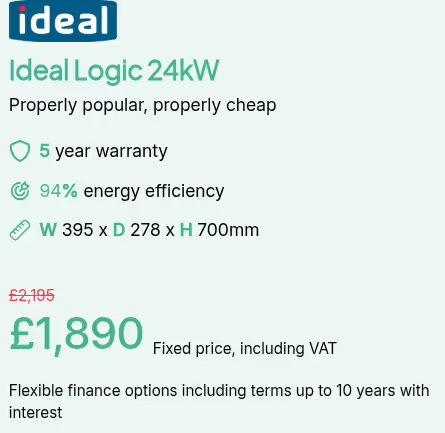
Before investing in either, check your boiler’s warranty. If your boiler is covered under warranty, your heat exchanger would be replaced for free. For the warranty to be valid, you’d need to have had your boiler serviced annually and have a magnetic boiler filter fitted.
Although your boiler may be out of warranty, that’s not to say the heat exchanger is. As an example, the Ideal Logic Plus comes with a 7-year warranty as standard. But as an added bonus, Ideal Heating offers a 10-year warranty on their heat exchanger.
When To Replace Your Boiler
If your boiler is over 10-years old and you're looking at a repair cost of £500+, it's likely more cost effective to replace it rather than repair it.
Whilst a £500+ heat exchanger replacement might fix your boiler for now, the other components in your boiler are still old and worn. That's going to lead to expensive repair bills in the future. And due to your boiler being out of warranty, you're the one that's going to be footing the bill.
And there are other savings to be had from new boiler installations. A typical A-rated gas boiler will work at 94% efficiency. By comparison, even a D-rated boiler is likely to be a less impressive 78%-82% efficient.
In a typical semi-detached property, switching from a D-rated boiler to an A-rated boiler is likely to save somewhere in the region of £180 per year.
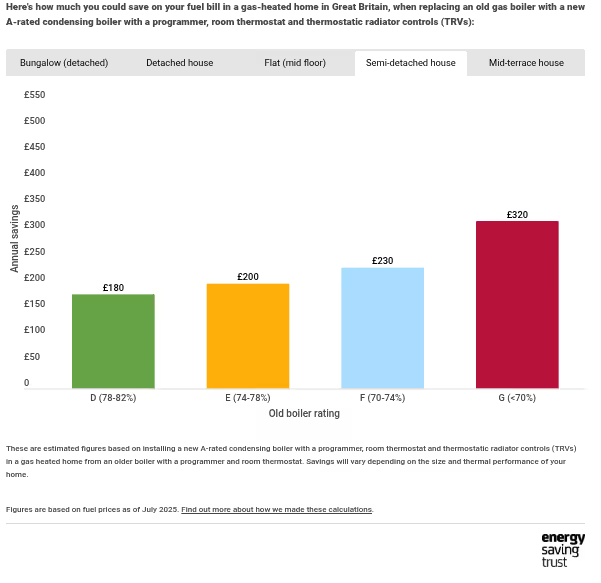
(Source: Energy Saving Trust)
When you combine your current repair bill (£450-£750 for a heat exchanger replacement), the potential for future repairs that aren't covered under warranty and energy bill savings, it makes more sense to replace your boiler rather than replace it.
To decide whether a boiler replacement is more cost effective than a repair, jump over to our boiler pricing page here.
When To Repair Your Boiler
When a repair bill of £500+ is on the horizon, it rarely makes sense to repair a boiler. The only time you'd go ahead with a repair is when you have a new boiler (under 5-years old) and in that case, it's likely to be covered by a manufacturer's warranty.
The most reliable boiler manufacturers such as Ideal, Vaillant, Worcester and Viessmann all supply boilers with warranties from 2-12 years.
To check your boiler warranty, first, you’ll need to know what boiler you have. This is usually displayed on the front casing, or a part number will be displayed underneath (near the filling loop) the main control panel.
Search this model name or part number online & “warranty” to see if your boiler is still covered.
Why Heat Exchangers Fail
The big question here is why did your boiler’s heat exchanger fail in the first place?
Below are the top reasons heat exchangers fail.
- Limescale
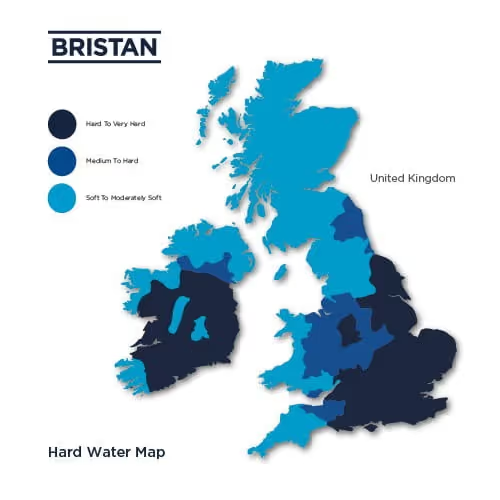
Limescale build-up is most prevalent in hard water areas. "Hard water" is water that contains a lot of minerals. And it's these minerals that build up on the heat exchanger's surface. Over time this build-up creates hot spots. This can warp the heat exchanger and eventually lead to cracks.
The best preventative measure here is fitting a limescale filter. This removes limescale before it ever reaches your heat exchanger.
Check out Bristan’s hard water map. If you live in a hard water area, your heating system is going to benefit from a limescale filter.
- Heating Sludge
Heating sludge creates the same problem as limescale; hotspots that can lead to heat exchanger damage.
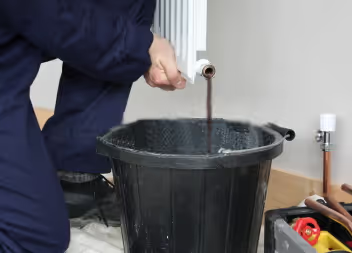
Sludge builds up, coming from boiler components, radiators, radiator valves and pipework. Over time, these rust particles break down into a black sludge.
This won't just damage your heat exchanger, but other boiler components too. It will also reduce the efficiency of your heating system and cause issues like radiators that are cold at the bottom (where heating sludge settles) or a blocked heating pump.
To protect your heat exchanger, get a boiler engineer to flush out your radiators and fit a magnetic boiler filter (supplied by the likes of TF1 and Adey).
- Thermal Stress (Age)
With every cycle of heating and cooling, your heat exchanger will expand and contract. Over time, this fatigues the metal and eventually, this is going to lead to a failure. Unfortunately, this is a simple case of wear and tear; there's nothing you can do to prevent it.
- Lack of Maintenance
Lack of maintenance is a common killer of boilers. To protect your heat exchanger (and other boiler components), make sure you:
- Have a system flush regularly
- Dose your system with heating inhibitor
- Ensure boiler pressure is correct (1-1.5 bar when cold)
- Remove debris from limescale and magnetic system filters with each boiler service
FAQ
Is using a boiler with a faulty heat exchanger safe?
It is potentially dangerous to use a boiler with a broken heat exchanger. Gases pass over the heat exchanger surface and if it's cracked, these cracks can allow carbon monoxide into your property.
Your boiler should be switched off and not used until it's been fixed by a Gas Safe engineer.
Is it cheaper to replace a heat exchanger or get a new boiler?
The cost of a new heat exchanger could be between £450-£750, with a new boiler costing upwards of £2,000. It's much cheaper to repair rather than replace.
However, if your boiler is old and unreliable, the most cost effective solution (long-term), is usually a replacement.
Is a faulty heat exchanger covered under warranty?
If your boiler is still under warranty, the heat exchanger should be replaced for free.
The likes of Ideal Heating have 10-year coverage on their heat exchangers (even if the boiler itself has a shorter warranty).
How long does it take to replace a heat exchanger?
Including diagnostic and repair, expect a replacement heat exchanger to take between 4-6 hours.
Is a leaking heat exchanger dangerous?
If your boiler engineer has confirmed you've got a cracked heat exchanger that's leaking, it's not safe to use your boiler. Switch it off at the mains and don't use it again until the heat exchanger has been replaced.
Can a heat exchanger be repaired rather than replaced?
No, unlike components such as the PCB and gas valve where wiring faults are usually to blame, it's likely your heat exchanger is cracked. The only way to fix it is to replace the heat exchanger, or the entire boiler.
Looking to get prices on a new boiler? Use our clickable new boiler quote page here.
