

Can a Heat Pump Work with Microbore Pipes? Your Questions Answered


Thinking about a heat pump?
If you’re wondering whether a heat pump could work in your home, we can give you a quick estimate and talk it through. No jargon, no pressure.
Think your home's microbore pipework rules out a heat pump? Think again.
One of the most common concerns we hear from homeowners at Dwellow is that their existing pipes are too small for a heat pump. And while microbore pipework can present challenges, it doesn't automatically mean a heat pump isn't an option.
In our latest YouTube video, which you can watch here or below, Dwellow takes you behind the scenes of a real installation using existing 8mm microbore pipework, explaining the calculations, design decisions and solutions that made it possible.
Here, we answer some of the most common questions about heat pumps and microbore pipes.
1. What is microbore pipework?
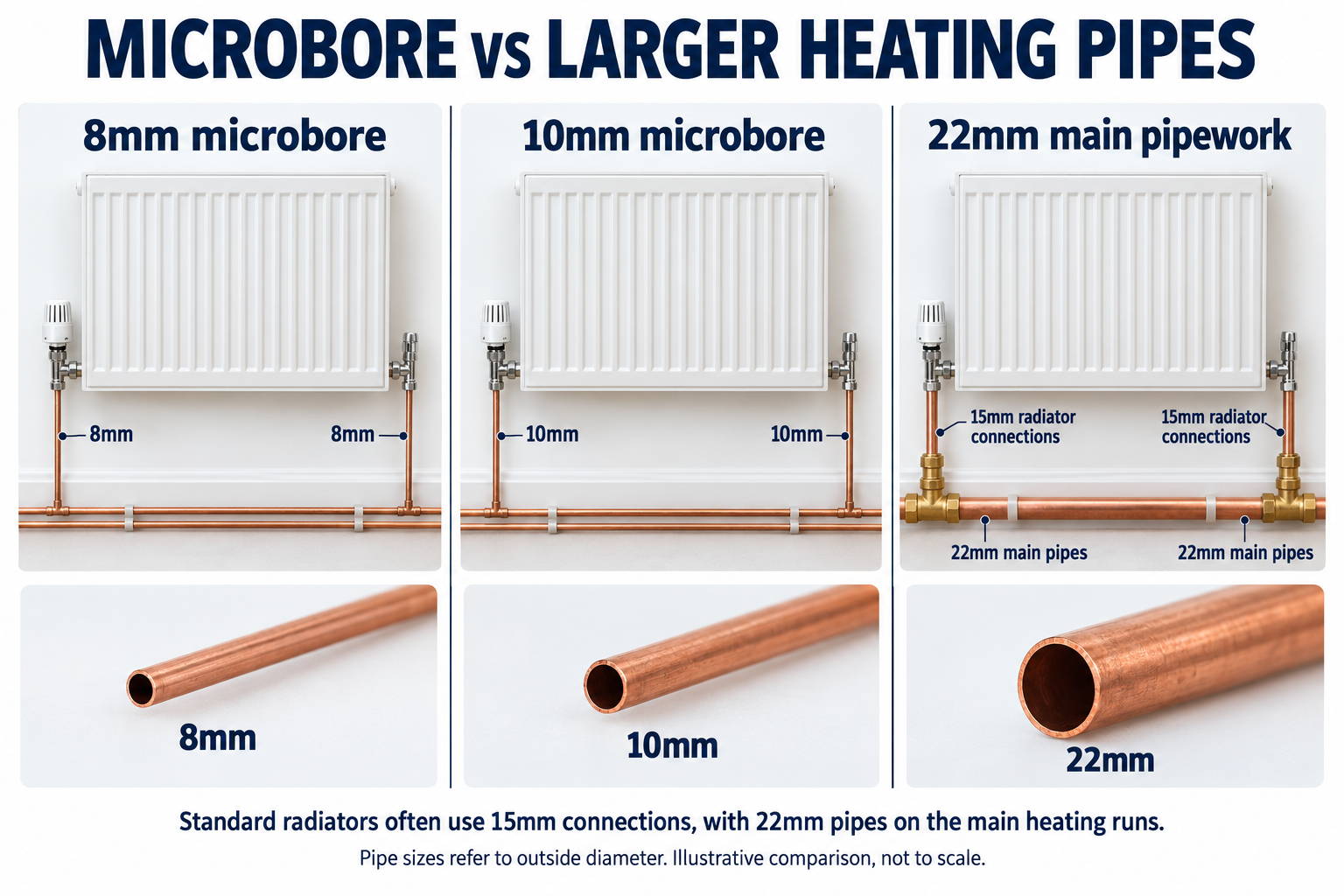
Microbore refers to central heating pipes with a smaller diameter than conventional pipework, typically 6mm, 8mm or 10mm.
Copper microbore was particularly popular in homes built or refurbished during the 1970s, 1980s and 1990s when central heating was being installed in huge numbers of homes across the UK.
Why? Because it was cheaper, quicker and easier to install, with the coiled copper pipes able to bend around corners and thread discreetly through floorboards, joists and cavities.
It is estimated that approximately 4 million homes had 8mm or 10mm microbore pipework.
Microbore is still used in many new-build homes today, although developers and heating engineers often use flexible plastic pipework, particularly 10mm pipes, to connect radiators.
Microbore pipework can be perfectly adequate for a gas boiler but in some cases it can be more challenging for a heat pump because of the higher water flow rates often required.
2. Can you install a heat pump with 8mm microbore pipes?
Yes, absolutely. Having 8mm microbore pipes doesn't automatically rule out a heat pump.
At Dwellow, we've successfully installed heat pumps in properties with existing 8mm microbore pipework.
However, whether it will work in your home depends on several factors, including the property's heat loss, the length and condition of the pipework, radiator sizing and the overall heating system design.
The important thing is to assess the entire system rather than making a decision based on pipe diameter alone.
3. Why can microbore pipes be a problem for heat pumps?
Heat pumps generally operate with lower water temperatures than traditional gas boilers.
They also typically work with a smaller temperature difference between the water leaving the heat pump and the water returning to it. This is known as delta T.
In our case study in the YouTube video above, the homeowner’s system was designed around a delta T of 5°C, compared with the 11–15°C difference commonly associated with boilers.
To deliver the required heating power with this smaller temperature difference, more water needs to circulate through the system.
Because microbore pipes are narrower, they create greater resistance to water flow. This can make it harder to achieve the flow rates needed for efficient heat pump operation.
But that doesn't mean the problem is insurmountable.
4. Will I need to replace all my microbore pipes to install a heat pump?
Not necessarily. In some homes, existing microbore pipework can be retained.
The key is determining whether the pipes can deliver enough heated water to each radiator without creating excessive resistance.
This requires a detailed heat loss assessment, accurate pipe sizing calculations and an understanding of the existing system.
In the installation featured in our video, we were able to retain the property's existing 8mm microbore pipework by adapting the system design.
5. Does the age of microbore pipework matter?
Yes. Older microbore pipes can become more restrictive over time due to internal build-up and deterioration.
For example, an 8mm copper pipe might have an internal diameter of approximately 6.8mm when new. Over time, deposits inside the pipe can reduce that opening.
Even a small reduction can significantly increase resistance to water flow.
That's why it's important to consider the condition of existing pipework, not just its original dimensions.
On our featured installation, we also thoroughly flushed the existing heating system before commissioning.
6. What is pressure drop, and why does it matter?
As water travels through pipes, it encounters resistance. This causes a reduction in pressure, known as pressure drop.
The longer and narrower the pipework, the greater that resistance can become.
A heat pump contains a circulation pump that moves water around the heating system. If the pressure drop is too high, the integrated pump may struggle to deliver the required flow.
Engineers therefore need to calculate whether the available pump pressure is sufficient for the system.
Particular attention is paid to the most demanding circuit, known as the index circuit, which is typically the circuit with the greatest pressure loss.
7. Can an additional circulation pump help overcome microbore restrictions?
Yes. In some cases, adding a secondary circulation pump can help an existing microbore system work successfully with a heat pump.
This was the solution we chose for the installation featured in our video.
Our calculations showed that the existing pipework could create too much resistance for the heat pump's integrated circulation pump alone.
Rather than replacing the microbore pipes, we installed a secondary pump to help maintain the necessary flow rate.
In this installation, the additional pump uses approximately 15–20 watts while running, which is comparable to the power consumption of a standard LED light bulb.
However, this isn't a universal solution. The right approach depends on the system's hydraulic design and individual requirements.
8. How do you know whether my existing microbore pipes will work?
It all starts with a detailed survey and heating system design.
At Dwellow, we calculate the heat loss of the property and individual rooms to establish how much heating power each space needs.
We then assess the existing pipework, including its diameter, length and condition, and calculate the flow rates and pressure losses throughout the system.
Using our own bespoke design software, we can model the heating system and identify potential problems before installation.
This allows us to determine whether existing pipework can be retained or whether modifications are needed.
9. Has Dwellow successfully installed a heat pump with 8mm microbore?
Yes. In our latest installation, we fitted a 5kW Vaillant aroTHERM plus heat pump in a property with existing 8mm microbore pipework at a property in Oxfordshire.
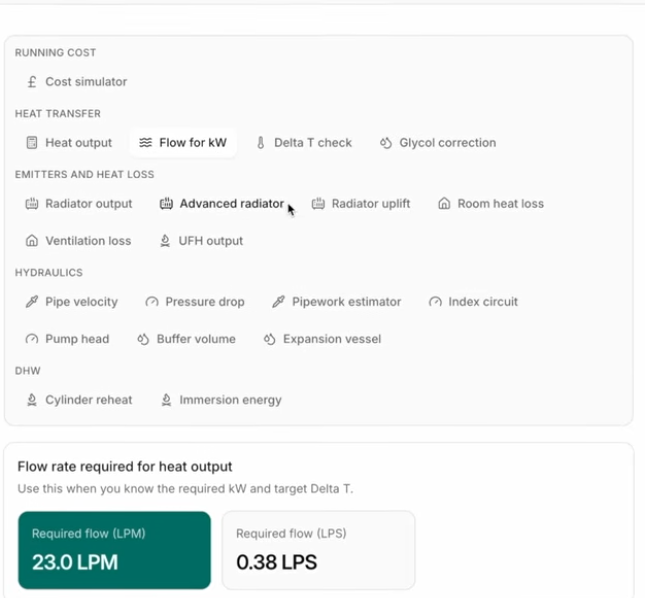
The property's calculated heat loss was just 3.3kW, with a required system flow rate of approximately 9.5 litres per minute.
Our initial calculations suggested that the existing pipework was close to the limits of the heat pump's integrated circulation pump.
When we accounted for the age and potential deterioration of the microbore pipes, we decided to incorporate a secondary circulation pump.
The result? We achieved our target flow rates during commissioning while retaining the existing microbore pipework.
We'll continue monitoring the system's performance during colder weather.
10. So, is my home suitable for a heat pump if it has microbore pipes?
Potentially, yes.
Microbore pipework can make heat pump system design more challenging, but it shouldn't automatically be a reason to rule out a heat pump.
Every home is different. The deciding factors are how much heat your property needs, whether your existing radiators and pipes can deliver it, and how the heating system is designed.
With careful surveying, accurate calculations and the right engineering solutions, some homes with even 8mm microbore pipework can successfully make the switch.
The takeaway? Don't let microbore pipes put you off exploring a heat pump. Get your system properly assessed before assuming you need to replace your pipework.
Watch our full video to see how we approached a real microbore installation, including the calculations and engineering decisions behind the finished system.
Are you interested in a heat pump? Get a tailored estimate in just two minutes here. Nothing complicated, and no pressure to continue.
