

Martin Lewis On Solar Panels: Costs & Savings
%2520(1)-2.avif)


Thinking about solar?
Curious what solar panels could save you? Get a quick estimate based on your home, and see if solar makes sense for you.
When it comes to anything financial, Martin Lewis is the go-to expert thanks to his huge money advice website, Money Saving Expert.
Being such a big website, MSE has multiple solar panel guides.
We've dug through each to highlight the most important things Martin Lewis’ blog says about solar panels, including:
- Installation costs
- Annual savings
- Time to breakeven
- Smart Export Guarantee (SEG) payments
- The cost of solar batteries
- Solar panel finance
Basically, does Martin Lewis think solar panels are worth it?
How Much Do Solar Panels Cost?
According to MSE, the average cost of solar panels is £6,100. That’s for a 3.5kW system.
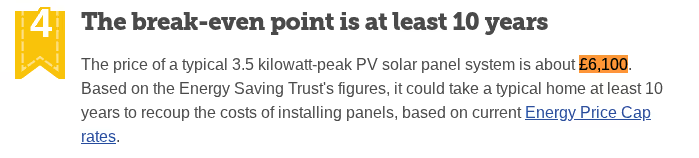
(Source: Money Saving Expert)
The majority of households are likely to need a 5kW solar panel system. That’s quite a lot larger than a 3.5kW setup, meaning the “typical” installation is going to be much higher than £6,100.
That said, our 12-panel 5kW system is competitively priced at just under £6,000 (close to MSE’s £6,100 estimate for the much smaller 3.5kW system).
This setup uses LONGi 430w monocrystalline panels that come complete with a 25-year warranty.
Alongside this, our package includes the likes of a hybrid inverter, bird guard and roof mounts.
We'll also apply to your District Network Operator, so you'll be able to receive payments via the SEG scheme for any excess electricity your system produces.
Of course, it’s worth mentioning that in general, most customers choose to include a solar storage battery as part of their package.
A standalone system typically provides around 20% electricity self-sufficiency. Adding even a small 5.3kW battery will bump this self-sufficiency rating to over 50% in a typical household.

Each household is different from the next, so installation costs for solar panels vary dramatically.
To get exact solar panel prices on a system that’s suitable for your property, jump over to our solar panel quote tool here.
Alternatively, check out our detailed guide covering the cost of installing solar panels here.
Is Installing Solar Panels Worth It?
Whilst solar panels are a massive investment, Martin Lewis’ Money Saving Expert suggests it’s worth it for those that have the savings:
“Yet if you've got savings you can use to pay for the panels (it's unlikely to be worth borrowing for solar panels, as the loan's interest could wipe out savings and extend the break-even point) it's worth doing the numbers for yourself.” - Money Saving Expert
Solar panels can save you £100s on electricity bills. However, it's worth considering the interest rate if you plan to use solar panel finance. High interest rates could eat into any cost savings, making installing solar panels unattractive.
It's also important to understand your system's capabilities versus your electricity consumption. That's going to determine exactly how much you can save.
And of course, you'll need to be making the most out of the Smart Export Guarantee (SEG) to truly make installing solar panels worth it. Using the SEG, you'll be able to sell any excess electricity your system produces back to the grid.
Alongside this, MSE also mentions that not all homes are suitable for solar panels.
"North-facing roofs aren't a great option for solar panels"
If the following applies to your property, installing solar panels isn't going to be worth it:
- North facing roof
- Shaded between peak hours of electricity production (10am-4pm)
- Small roofs that don't have enough space to install a sufficient number of solar panels
- Roofs in poor condition (they need reasonable structural integrity to take the weight of PV units)
Still not sure if your property is suitable for solar panels?
Read our detailed coverage of whether solar panels are worth it here.
How Much Do Solar Panels Save On Electricity Bills?
If you’re trying to determine how much you’re likely to save on your electricity bills, it’s going to vary depending on the source you read, system installed and your energy consumption.
Other factors that affect how much you save include whether or not you have a solar storage battery. And of course, if you're tapped into the Smart Export Guarantee scheme (to generate income from excess electricity).
That said, Martin Lewis’ Money Saving Expert estimates an annual saving of £190-£350 per year, based on the current Energy Price Cap.
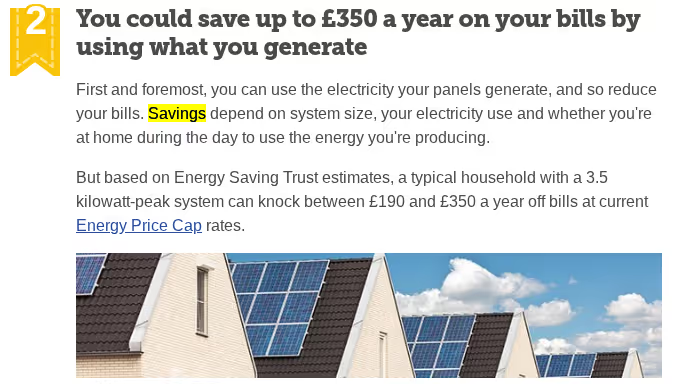
If your main concern before installing solar panels is cost savings, read our detailed guide to how much solar panels can save on electricity bills here.
What's The Breakeven Point For Solar Panels?
Money Saving Expert suggests that the breakeven point for solar panels is at least 10 years.
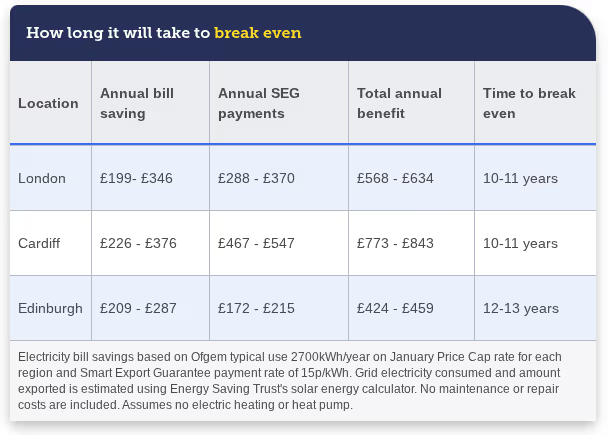
This is based on a 3.5kW system costing £6,100 on average. However, we've already mentioned that our base system is under £6,000 and is 5kW, so it's possible to breakeven in less than 10 years.
There are factors that affect the breakeven point (a.k.a. payback period) for solar panels such as:
If you’re looking at solar panel installation as a long-term investment and want more details on what you’re likely to save and when you’d breakeven, check out our payback period guide here.
How Much Are Smart Export Guarantee Payments?
To maximise what you get from the Smart Export Guarantee, you’ll want to investigate energy supplier’s tariffs.
As you can see on Money Saving Expert’s pricing table below, SEG payments vary massively.
If we’re looking at each end of the spectrum, you’ll generally see SEG prices of 1p-25p per kWh of electricity exported.
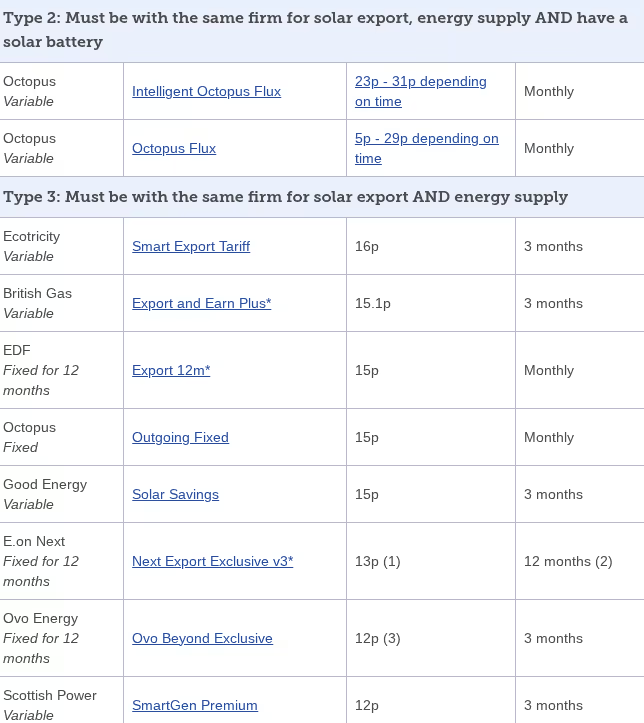
(Source: MSE)
Remember, you’re able to switch your SEG supplier and/or the company you use for your electricity. But, you’ll want to compare both the new SEG rate and your new electricity tariff. It might be that the one outweighs the other and you’re actually better off staying put with your current supplier.
Want to know more about the Smart Export Guarantee and how much you can get paid?
Read our guide to the SEG for solar panels here.
How Much Do Solar Batteries Cost?
Money Saving Expert suggests the average battery cost to be at £4,500. At that price, it’s going to add on years to your breakeven point.
However…
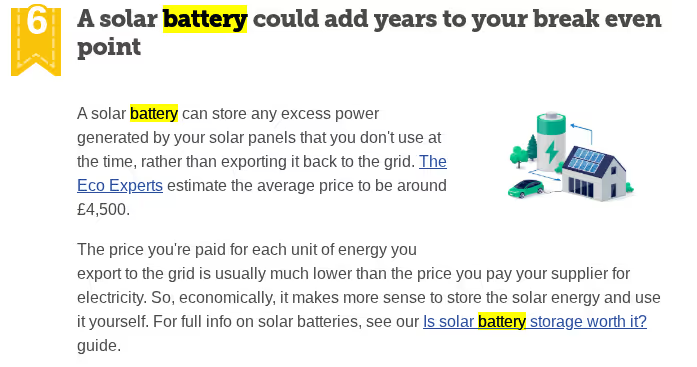
…solar storage batteries can be installed for a lot less than the £4,500 average mentioned.
Our solar panel systems are under £6,000 for a 5kW setup (compared to MSE’s estimate of £6,100 for an average 3.5kW).
Likewise, our average battery cost is lower too. The majority of customers choosing to install a battery tend to go for either a small or medium unit.
Our solar storage batteries cost:
- Small 5.3kW: £2,495
- Medium 10.6kW: £3,745
- Large 15.9kW: £4,995
MSE are right in the fact that a solar battery provides more self-sufficiency, but generally adds on a little to the payback period.
For instance, a solar panel installation utilising a small battery would see a payback period of approximately 11-years. If you jump to a large battery, whilst your electricity self-sufficiency jumps significantly, the payback period would rise to approximately 13-years.
Want to find out more about your storage options? Check out this guide to solar battery prices.
What To Avoid With Solar Panel Finance
Martin Lewis’ MSE makes a good point here:
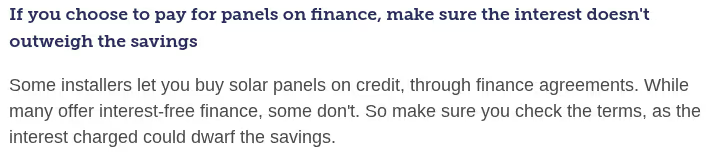
Put simply, some installers offer finance, but at a high interest rate. If it’s too high, the cost of finance could actually outweigh any savings you’re likely to make.
Taking their baseline of a minimum of 10-years to breakeven on your solar panels, an APR above 10% is going to make finance unfeasible.
Of course, the caveat to that is that solar panels are generally under warranty for 25-years. So, even after the 10-year period (breakeven), you’ll still have 15-years+ of use left in the tank.
We’ve written a detailed guide to solar panel finance here.
And if you use our solar panel quotation tool here, we offer various payment options (including finance).
