

Do Air Source Heat Pumps Heat Hot Water?
.avif)

Thinking about a heat pump?
If you’re wondering whether a heat pump could work in your home, we can give you a quick estimate and talk it through. No jargon, no pressure.
Air source heat pumps are becoming increasingly popular in the UK as a direct replacement for gas boilers. They’re able to work at over 400% efficiency (4kWh of heat produced for every 1kWh of electricity consumed), compared to 94% efficiency you’ll get with an A-rated gas boiler.
One of the questions we're asked most frequently is whether heat pumps can heat enough hot water to supply 3-5 bedroom properties.
In short, the answer is yes.
If your installer has fitted the correct sized air source heat pump, it will be able to meet both your hot water and central heating demands. However, it will work in a slightly different way to a typical combi boiler.
Below we'll explain in more detail, covering the likes of:
- Can a heat pump generate enough hot water for your property?
- The best high temperature heat pumps
- How do they produce hot water?
- What you need to know about hot water cylinders
- How combi boilers differ from air source heat pumps
Can A Heat Pump Generate Hot Water?
Yes, heat pumps are designed to provide properties with both hot water and central heating.
Most taps and showers will usually require hot water to be delivered at 40°C or higher. Even an air source heat pump using a low flow temperature will be able to provide a hot water temperature of 45°C or higher.
One thing worth considering, is that an air source heat pump won't heat hot water on demand.
Instead of heating hot water on demand (like a combi boiler), a heat pump's hot water is slowly built up in a hot water cylinder over time. Sometimes this hot water's temperature is maintained or boosted by an immersion heater that’s built into the cylinder.
This allows a heat pump to be a lot more efficient than a gas boiler. But, it does mean that having the right size heat pump, coupled with the correct size cylinder is incredibly important.
Top High Temperature Heat Pumps
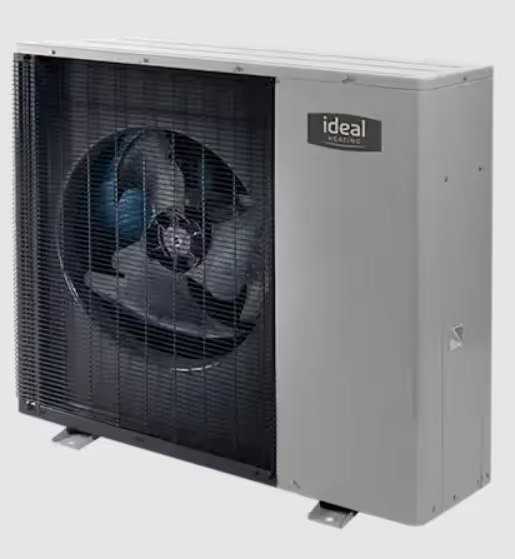
If you're worried that a standard heat pump won't provide enough heat to provide your property with hot water and heat, it's worth looking at specific units called "high temperature heat pumps".
You can get prices on a system that utilises a high temperature pump using our clickable heat pump quote form here.
A typical heat pump will have a flow temperature of around 40-55°C, much less than a gas boiler that works at around 65°C. This isn't necessarily a problem, as a heat pump's efficiency comes from working "low and slow".
However, some high temperature heat pumps offer hot water flow temperatures of up to 70°C. During the colder months where you're struggling to get enough hot water, this higher flow temperature can help.
Top high temperature heat pumps include the likes of the:
- Ideal Logic Air
- Vaillant aroTHERM Plus
- Daikin Altherma HT
- Samsung HTQ
- Viessmann Vitocal
We’ve written a detailed guide to high temperature heat pumps here.
Or, if you want to know the exact setup needed to provide enough hot water and heat to your property, speak to our heat pump advisors here.
How Heat Pumps Produce Hot Water
In order for a heat pump to generate enough hot water it uses a combination of a: fan, refrigerant, compressor and a heat exchanger.
First, the fan pulls in air from the outdoors (this is why it's important to keep fan blades clean and free of obstruction). At this point, the refrigerant absorbs any heat from the air (different refrigerants have different levels of efficiency).
The majority of heat for hot water and your central heating is generated from the compressor. It compresses refrigerant/gases to create energy which in turn, increases heat.
And in the final step, the heat exchanger transfers this heat to water. This water then flows to radiators or your hot water cylinder via flow pipes.
Water flows back to the heat pump (cooling as it goes) via the return pipes and the whole process starts again.
Heat Pump Hot Water Cylinders
Your hot water cylinder is an integral part of your air source heat pump setup. Many top manufacturers produce cylinders specifically for heat pumps, or, at least ones that are compatible.
For those looking at the Ideal Logic Air, Ideal Heating produces the Logic Air Pre-Plumbed Cylinder. This is available in a 150L-300L capacity; you'll want one at the bigger end if you're a high hot water consumption household.
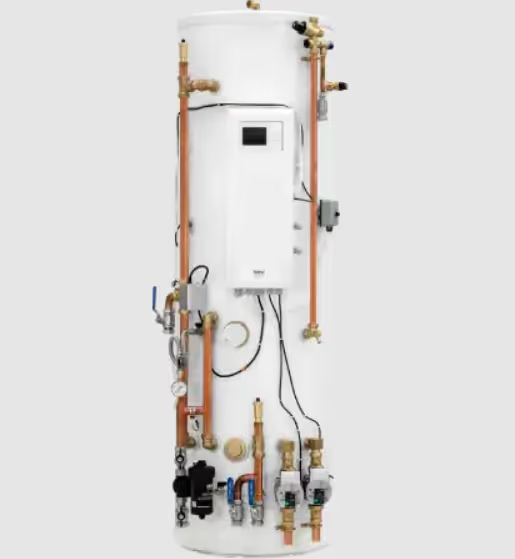
This cylinder doesn't just store hot water (transferred via the cylinder coil), it's able to heat hot water if it's not up to temperature. This is thanks to the built-in immersion heater (typically 3kW) which comes pre-installed from the factory.
Other popular choices for hot water cylinders include the likes of:
- Vaillant Unistor
- Mitsubishi Electric Ecodan
- Daikin Altherma
For an overview of popular cylinders, check out our guide to heat pump hot water cylinders here.
How Do Heat Pumps Differ To Combi Boilers?
As we’ve mentioned, combi boilers can heat hot water on demand. A heat pump’s hot water isn’t “on demand”, it builds it up over time and stores it in a hot water cylinder.
And what this means, is you’ll need a suitable space to house a cylinder. The actual space you’ll need will depend on the size (150L-300L is typical) and type (horizontal or vertical).
As an example, a vertical 300L cylinder is going to be over 2m high, 700mm wide and 780mm in depth. You'll also need adequate space around the cylinder to aid the installation. Typically, this means you'll need a large space in either an airing cupboard or loft.
You’ll also need a suitable outdoor space to install a heat pump. Put simply, combi boilers require a lot less space, but their efficiency is lower.
You can get quotes on your heat pump and cylinder using our heat pump quote form here.
